

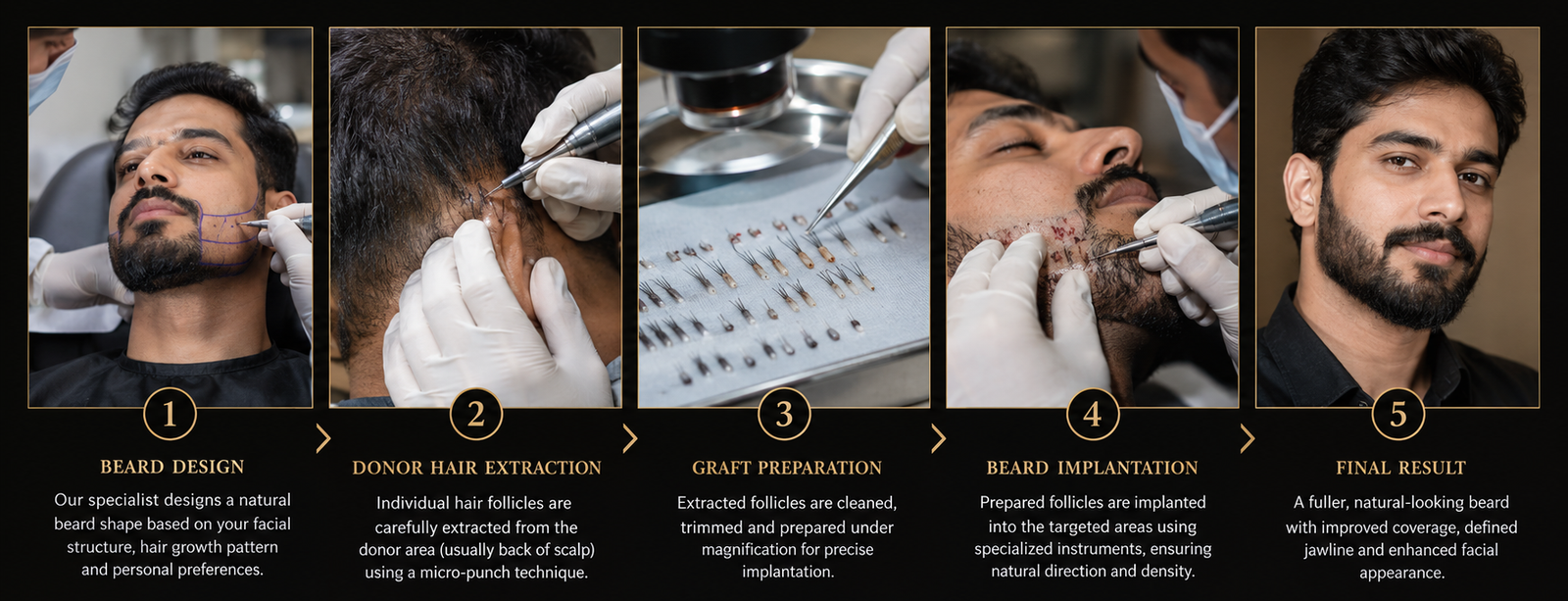
A beard transplant is a hair restoration procedure that transfers hair follicles from a donor area to parts of the face where beard growth is sparse or absent. At Avanza Clinic, treatment planning considers the patient's facial features, existing beard growth, donor hair availability, and desired beard shape. The micro-FUE technique is described on this page. A consultation helps determine suitability, discuss the treatment plan, and explain potential outcomes and limitations. If you are considering a beard transplant in Mumbai or Raipur, contact Avanza Clinic to discuss the available consultation options.
A Beard transplant operation is the transplantation of grafts taken from the donor area at the back of the head or lower part of the chin where the beard is dense to the areas on which beard loss is observed due to trauma, cut, or so on, through micro FUE method. The operation performed under local anesthesia lasts for about 8 hours and is painless after local anesthesia. With a single application, the rate of successful results is high. Some people may need a second operation. Beard, an important appearance criterion for men in today’s world, is corrected by giving different models by barbers, but a definite treatment for the loose beard is beard transplantation. One of the advantages of beard transplantation is that the beard’s shaping will be done at the planning stage of beard transplantation. A Beard shape suitable for the person’s face is selected together, and the beard is transplanted to the person within this plan and is used lifelong.
Avanza Hair Clinic promises realistic results to the patients. Patients are not misled about the number of grafts and the results of the beard transplantation. Before the beard transplant operation, surgery planning is done by the doctors.
Although the procedure is an aesthetic operation and what you want is important, it would be a good choice to consider your doctor’s recommendations.
One of the most critical points in the planning step is the evaluation of the neck, head, face, forehead area of the patient and examining the hair follicles, and to explain all the possible results that the patient may encounter, no matter what, and to have a realistic expectation. Otherwise, individuals feel deceived and disappointed. To avoid this, it is always best to seek professional support from clinics that you believe you can trust.
In Avanza Hair Clinic, beard transplantation treatment with micro FUE method has been applied to different people from many countries worldwide, and successful results have been obtained. All stages of the operation are performed under doctor’s’ supervision who have many years of experience in their field, using the latest technology devices. People are informed in detail and with realistic approaches about the whole beard transplantation process.
 Hair Transplant
 Beard Transplant
 Growth Factor
Concentrate
Growth Factor
Concentrate
 Platelet-Rich Plasma
.png "Man") Hair Booster Program
Hair Booster Program